
Lighting Mistakes That Hide Your Salt Lake City Home's Best Features
You pull into the driveway after a long day. The garage door opens, you glance at the front of your house, and... it looks like a gas station. Two floodlights mounted under the eaves are blasting white light across the entire facade, flattening every bit of texture on that beautiful ledgestone you paid good money for. The shadow detail? Gone. The depth in the stacked stone around the front door? Completely washed out. Meanwhile, your neighbor's place down the street in Draper has this warm, inviting glow that makes every architectural detail pop. Same neighborhood. Same price range. Totally different feel. The difference isn't budget. It's approach. And honestly, the most common outdoor lighting mistakes are the ones homeowners don't even realize they're making.
After years of designing permanent lighting systems across the Wasatch Front, we've seen every version of these mistakes. From Sandy subdivisions to the hillside custom builds above Cottonwood Heights, the same handful of errors keep showing up. The good news is they're all fixable. Let's walk through the biggest ones so you can avoid them, or finally understand why your current setup isn't doing your home justice.
The Parking Lot Effect: When More Light Means Less Beauty
This is the one we see most often, and it's the one that hurts the most. A homeowner wants their house to look great at night, so they install two or three high-output floodlights and aim them straight at the front wall. Makes sense on paper, right? More light equals more visible equals more attractive.
Except that's not how it works.
When you blast a flat wall of light across your home's facade, you eliminate shadows. And shadows are what give texture its depth. That Utah ledgestone along your foundation, the stacked cultured stone framing your entryway, even the subtle relief patterns in stucco, all of it relies on light hitting at angles to create dimension. Flood it head-on, and everything flattens. Your $15,000 stone veneer suddenly looks like a painted concrete wall.
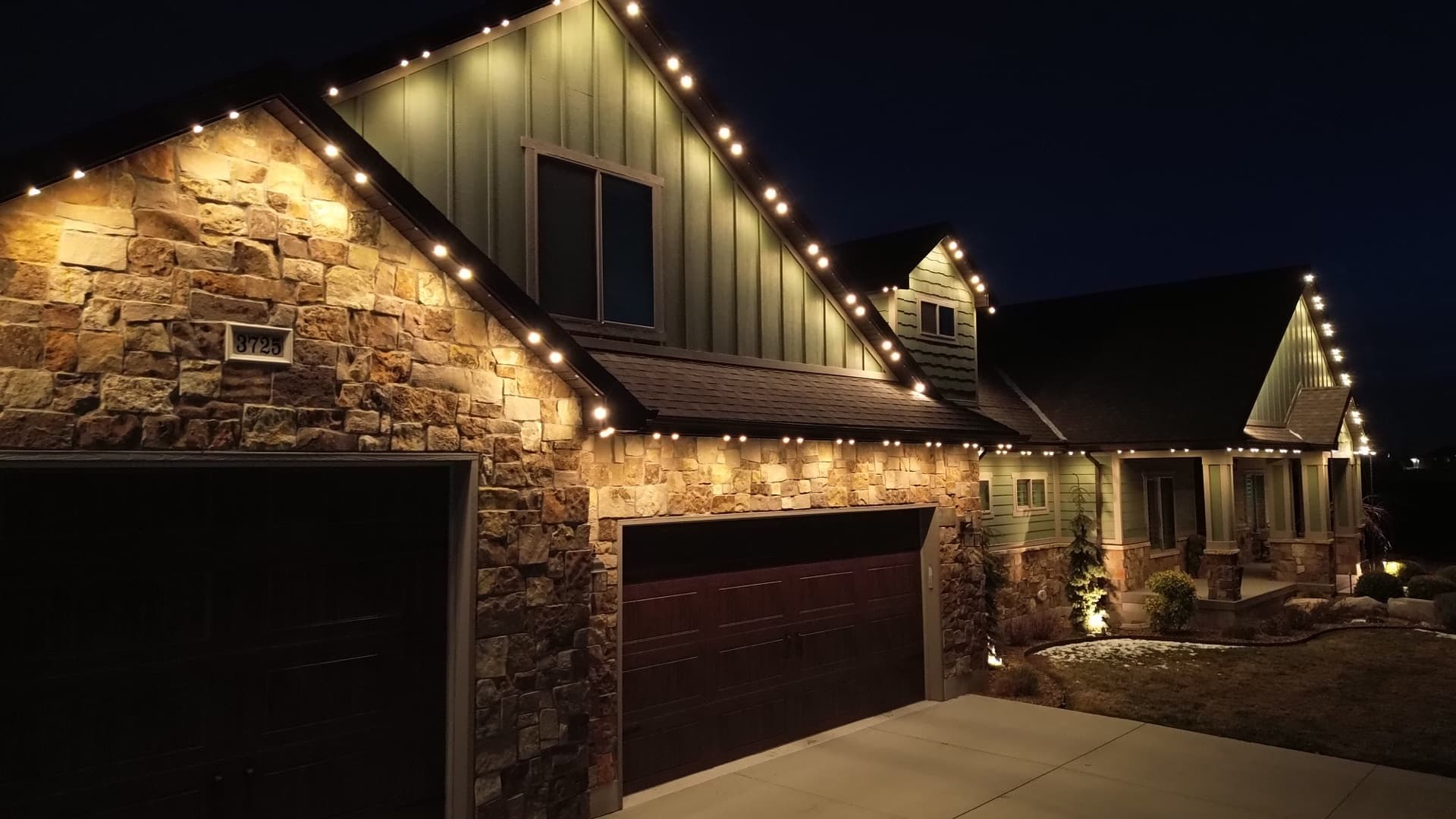
The fix is intentional, layered lighting. Instead of two big floods doing all the work, a permanent LED system lets you place individual light points along the roofline and soffits, each one carefully aimed to graze down the surface at an angle. This creates the kind of shadow play that actually shows off material quality. It's the difference between a passport photo and a portrait.
We see this transformation constantly in neighborhoods like Herriman and Riverton, where newer construction uses a mix of stone and stucco on the front elevation. Those material transitions look incredible with angled downlighting, but they disappear completely under a floodlight.
The Wrong Color Temperature Is Killing Your Curb Appeal
This one is sneaky because most homeowners don't even know color temperature is a choice. They buy whatever LED comes in the box, screw it in, and assume the color is just "white." But white light exists on a spectrum, and the wrong spot on that spectrum can make your home look cold, sterile, or just plain wrong.
Here's the quick version. Color temperature is measured in Kelvin. Around 2700K-3000K, you get a warm, golden tone. At 4000K, it's a neutral white. Push past 5000K, and you're into cool, bluish territory, the kind of light you'd see in a hospital corridor or a commercial parking garage.
Now think about the materials on most Wasatch Front homes. Warm-toned sandstone. Buff and tan stucco. Cedar accents. Earth-toned brick. These materials were chosen because they complement the natural landscape, the tawny foothills, the golden hour light that hits the Oquirrh range every evening. When you throw 5000K cool white light on those warm surfaces, the color drains right out of them. Tan stucco goes gray. Warm stone looks lifeless. Cedar turns an odd, washed-out color that doesn't exist in nature.
The sweet spot for most Utah homes is 2700K to 3000K warm white. It flatters earth tones, makes stone look rich, and creates that "warm evening glow" that draws the eye without feeling harsh. This is actually one of the reasons we use the system we do. TruLight's RGBW nodes have 6 LEDs each, broken into 3 RGB and 3 dedicated warm white LEDs. When you run just the warm whites, you get a true, rich warm light that flatters every stone and stucco surface we've ever installed on. No blue tint, no green cast. Just clean warmth.
And when you want a brighter, crisper white for something like a holiday display or a party, you fire all 6 LEDs together. The warm whites blend with the RGB whites to produce a true pure white that's 2-3x brighter than competitor systems. You get both options from the same hardware, which means you're never stuck with a color temperature that doesn't match the moment.
Forgetting the Roofline (and Losing Half Your Home)
Here's a scenario we see all the time, especially in South Jordan and Sandy. A homeowner puts path lights along the walkway, maybe a couple of uplights on the trees, and calls it done. The landscaping looks nice. But from the street, the top half of the house just... vanishes into the night sky.
Your roofline is one of the most defining architectural features of your home. Gable peaks, dormers, the overhang of a covered porch, fascia detail. All of that disappears after sunset if you only light from the ground up. And in our market, where homes are often viewed against the dark silhouette of the Wasatch Range, a missing roofline can make even a large home feel small and undefined.
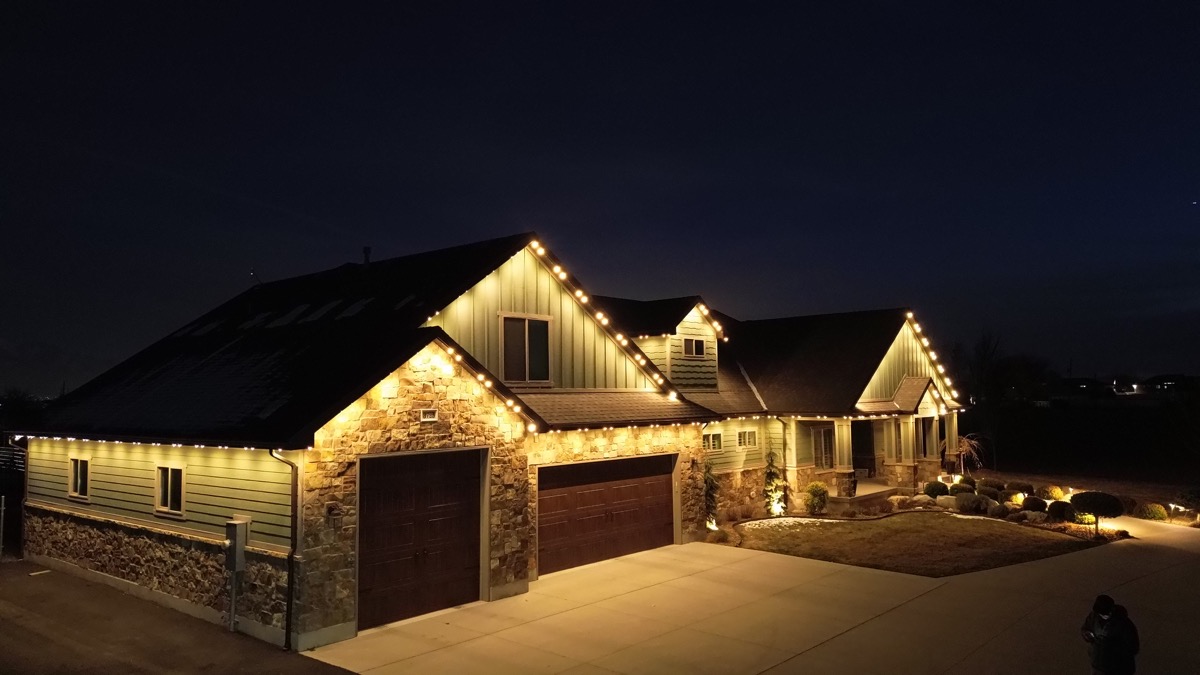
Permanent lighting installed along the roofline solves this completely. Downlighting from the eaves washes the facade with controlled light, while the roofline itself becomes a clean, visible line that defines your home's shape against the sky. On homes along the Draper hillsides, where you're often looking up at the house from the street below, this effect is especially dramatic. The entire silhouette comes alive.
The best part? Roofline-mounted permanent lighting also doubles as your soffit wash, your accent lighting, and even your holiday lighting. One installation, multiple functions, year-round.
One Zone, One Switch, Zero Flexibility
We call this "all-or-nothing lighting," and it's painfully common. Every exterior light on the house is wired to one switch or one timer. It's either all on, full blast, or all off. There's no in-between.
Think about how you actually use the outside of your home. On a Tuesday night in February, you probably just want some soft accent light on the front facade and a bit of illumination by the garage. But on a Saturday evening in July, when you've got friends over on the back patio, you want the entire house glowing with warm light and maybe some color on the back deck. Those are completely different lighting needs, and a single-zone setup can't accommodate either one well.
Zone control changes everything. With an app-controlled system, you can set the front of the house to a warm 30% glow for everyday evenings, crank the backyard zones to full brightness for entertaining, and keep the side yard on a motion-sensor-activated setting for security. Different zones, different brightness levels, different schedules, all managed from your phone.
This is one of those features that homeowners in Cottonwood Heights and Holladay tell us they didn't think they needed until they had it. Once you can adjust zones independently, you start noticing how much more livable your outdoor space becomes. You're not over-lighting the bedroom side of the house while trying to light up the patio. You're not blinding yourself walking to the mailbox because the only option is "full power." It's just smarter. If you're curious about how zone control and color scenes work in practice, our post on outdoor mood lighting breaks it down in more detail.
The Holiday-Only Mindset
December rolls around and suddenly everyone in Daybreak is up on a ladder, wrestling with tangled C9 strings, pinching gutter clips onto frozen fascia boards, and praying they don't slip on the frost. Six weeks later, they're back up there taking it all down, inevitably leaving a few clips behind that they'll notice every time they pull into the driveway until spring.
Sound familiar?
The holiday-only mentality means homeowners only think about exterior lighting for about 45 days a year. But your home exists in the dark for roughly 4,000 hours annually here along the Wasatch Front. That's a lot of time for your biggest investment to be invisible.
Wondering what it would cost for your home? Get an instant estimate using our satellite tool. No visit required.
Get Your Free QuotePermanent lighting flips this equation. Yes, you get holiday colors whenever you want them, red and green for Christmas, orange and purple for Halloween, pastels for Easter, blue and white for Hanukkah. But you also get 365 days of accent lighting, security lighting, and curb appeal that traditional holiday lights can never provide. The system sits flush against your roofline in a low-profile track that practically disappears during the day. No seasonal installation. No ladder risks. No pile of tangled lights in the garage.
We've had homeowners in Eagle Mountain and Lehi tell us that the accent lighting they use the other 11 months of the year ended up being more valuable to them than the holiday colors. There's something about pulling up to a well-lit home every single night that just feels good. It changes how you see your own house.
Cheap RGB and the "Purple White" Problem
This mistake has gotten more common as budget RGB systems have flooded the market. A homeowner installs an RGB-only permanent lighting system, sets it to "white," and then can't figure out why it looks off. The white has a purple or blue cast. It's dim. It looks cheap compared to the crisp white lights on the house down the street.
Here's why. An RGB system creates white light by mixing red, green, and blue LEDs together. In theory, equal parts of all three make white. In practice, the result is always a compromise, especially at the budget end. You get a cool, slightly tinted "white" that's noticeably dimmer than what a dedicated white LED can produce. On a warm-toned Utah home, that faint purple or blue undertone is immediately visible. It makes the whole installation look like a toy.
This is exactly the problem that RGBW systems were designed to solve. By including dedicated warm white LEDs alongside the RGB LEDs, you get the full color spectrum for holidays and events, plus a true, clean, bright white for everyday use. TruLight's 3+3 configuration (3 RGB + 3 warm white LEDs per node) means the warm white mode alone is already brighter than most competitors running all their LEDs at full power. And when you blend all 6 LEDs together for that true pure white, you're getting 2-3x the brightness of standard RGB-only systems. The difference is visible from across the street.
If you've ever wondered about the technical difference and why it matters so much, we wrote a full breakdown of RGB vs. RGBW that goes deeper into the engineering.
Visible Hardware That Ruins Daytime Curb Appeal
Your lights might look great at 9 PM. But what about 9 AM?
One of the most overlooked aspects of outdoor lighting is what the system looks like when it's off. Bulky track housings, visible wiring runs, mismatched clips, and sagging cable all become eyesores in daylight. And here along the Wasatch Front, where our UV intensity at altitude is significantly higher than at sea level, cheap plastic housings and adhesive-mounted fixtures degrade fast. The sun up here is relentless. Give a bargain system two summers and you'll see yellowed plastic, curling adhesive, and faded finishes.
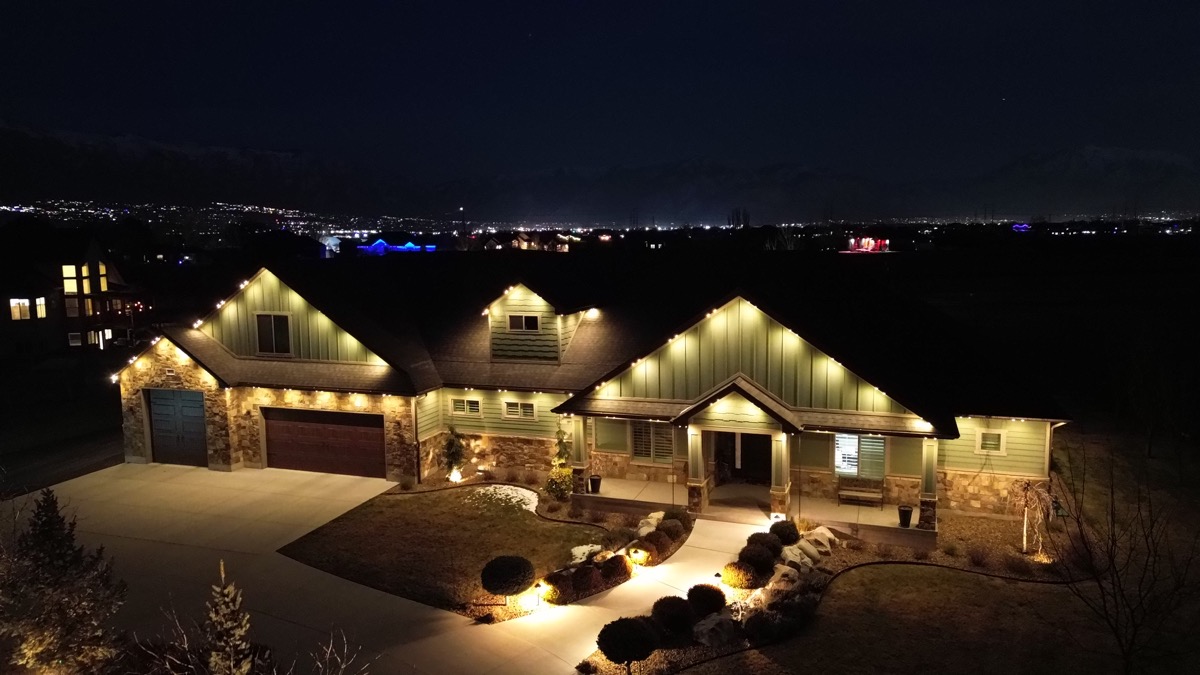
A well-designed permanent system uses a low-profile aluminum track that tucks up under the fascia or into the soffit line. From ground level, it's virtually invisible. The track color matches common trim colors, the wiring is completely concealed, and the individual LED nodes sit recessed so they don't protrude. When the lights are off, your home looks exactly the same as it did before installation.
This matters more than people realize. Homes in neighborhoods like Cottonwood Heights and Holladay, where mature trees and thoughtful landscaping are part of the streetscape, need hardware that respects the daytime aesthetic. Nobody wants to solve their nighttime lighting problem by creating a daytime eyesore.
Light Trespass: Don't Be That Neighbor
This one is less about your home's appearance and more about being a good neighbor. But it still falls under "lighting mistakes that hide your home's best features" because light that spills off your property is light that's not doing anything useful on your property.
Light trespass happens when fixtures are aimed too wide, too high, or with too much intensity. Your goal is to wash your own facade and landscape with light, not illuminate the neighbor's bedroom window. In tighter lot configurations, like you see in newer Herriman developments or Daybreak, houses are close enough together that an aggressive lighting setup can genuinely cause problems. Nobody wants to be the house that everyone on the street quietly resents.
The fix is precision aiming and appropriate brightness. Roofline-mounted downlighting naturally directs light onto your own home and the ground immediately below it. It doesn't spray sideways or upward into the sky. Zone control lets you dim or turn off lights on the side of the house that faces a close neighbor, while keeping the street-facing front fully lit. And motion sensor integration means lights in certain zones can stay off until someone actually approaches, which is both neighbor-friendly and great for security.
TruLight's 48V system also plays a role here. The higher voltage means the system can run at lower current while maintaining brightness, which translates to more precise light control and less wasted spill. Compared to 12V or 24V systems that need to push harder to achieve the same output, you get cleaner, more focused light where you actually want it.
Frequently Asked Questions
What color temperature is best for Utah stone and stucco homes?
For the warm earth tones common across the Wasatch Front, 2700K to 3000K warm white is the sweet spot. This range flatters sandstone, buff stucco, and cedar accents without making them look washed out or gray. Avoid anything above 4000K on warm-toned exteriors. If your home has cooler gray stone or contemporary dark finishes, a neutral 3000K-3500K can work well, but warm white is the safe bet for most SLC-area homes.
Can permanent lighting replace my holiday lights completely?
Yes, and most homeowners find it does far more than replace them. A permanent RGBW system gives you full-color holiday displays (red and green, orange and purple, any combination you want) plus year-round accent lighting, security lighting, and architectural highlighting. You control colors and patterns from an app, so switching from everyday warm white to a full holiday display takes about 30 seconds. No ladders, no installation appointments, no storage bins in the garage.
How do I avoid bothering my neighbors with my outdoor lights?
The key is roofline-mounted downlighting instead of ground-mounted uplighting or wide-angle floods. Downlighting naturally contains the light to your own facade and property. Pair that with zone control so you can dim or turn off sides of the house that face close neighbors, and motion sensor activation for low-traffic zones. This approach gives you full lighting impact from the street while keeping your neighbors comfortable.
How long does permanent outdoor lighting actually last?
Quality LED permanent lighting systems are rated for 100,000+ hours of operation. To put that in perspective, if you ran the lights for 8 hours every single night, that's over 34 years of use. TruLight systems are backed by a lifetime warranty, so you're covered for the long haul. The aluminum track housing is designed to handle Utah's full range of conditions, from summer UV at altitude to winter freeze-thaw cycles and everything in between.
Related Articles
If any of these mistakes sound familiar, you're not alone. Most homeowners across Salt Lake City and the surrounding areas are working with some version of these issues, because until recently, there just weren't great options for permanent exterior lighting. The technology has caught up, though. If you'd like to see what your home could look like with a system designed to actually show off its best features instead of hiding them, reach out to us at TruLight and we'll walk you through what's possible. No pressure, no hard sell. Just a conversation about your home and what good lighting can do for it.